
Description
According to WHO, emerging infectious diseases are classified as “diseases caused by newly-identified or previously unknown pathogens causing public health concerns at the local as well as at the international level”.
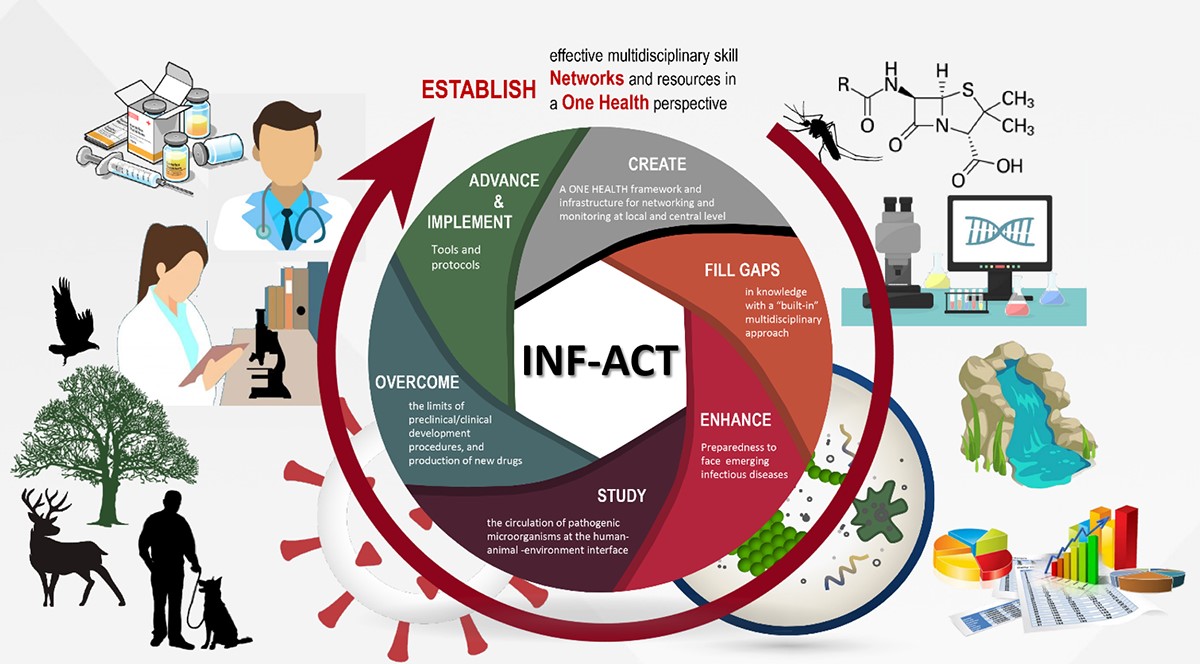
In this context, this Extended Partnership (PE) project opportunity on the topic of emerging and re-emerging infectious diseases with epidemic/pandemic potential offered by the National Reprise and Resilience Program (NRRP), represents a formidable tool to: – fill gaps in knowledge of the biological characteristics on highly diffusible pathogens with a “built-in” multidisciplinary approach; – enhance the level of basic knowledge on highly diffusible pathogens and, in case of vector-borne diseases (VBDs), their arthropod vectors. – create a framework and infrastructure for centralized systematic monitoring of the genomic characteristics and evolution of multiple pathogens with epidemic potential circulating in humans, animals and in the environment; – study the circulation of pathogenic microorganisms at the human-animal interface (both domestic and wild) and the risk of spill-over events; – define shared protocols for the implementation of monitoring and contrast measures through the application of innovative tools – set up a network and infrastructure for the centralized systematic monitoring clinical markers comprising clinical severity in adults and children, immune responses, as well as gender based differences; – overcome the limits of preclinical/clinical development procedures, and production of new drugs with new technological solutions – establish effective multidisciplinary skill networks and resources; – advance tools optimizing the use of data from multiple sources for One Health early warning, risk assessment and for the prioritization of public health interventions to improve the country’s overall preparedness towards potential emerging (and even re-emerging) infectious threats to public health.
Objectives and expected results
Project proponents and involved entities
- Consiglio Nazionale delle Ricerche (CNR)
- University of Pavia (UniPV)
- University of Padua (UniPD)
- University of Catania (UniCT)
- Italian National Institute of Health – Istituto Superiore di Sanità (ISS)
- University of Milano (UniMI)
- University of Rome “Sapienza” (UniSAP)
- University of Bologna (UniBO)
- Association of Italian Veterinary Public Health Institutes – Associazione Istituti Zooprofilattici Italiani (AIZS)
- Fondazione Bruno Kessler (FBK)
- University of Siena (UniSI)
- University of Cagliari (UniCA)
- University of Naples “Federico II” (UniNA)
- University of Bari “Aldo Moro” (UniBA)
- University of Turin (UniTO)
- Humanitas University (HUniMED)
- Fondazione Istituto Nazionale di Genetica Molecolare, Milano (INGM)
- Istituto di Ricerche Farmacologiche “Mario Negri” IRCCS, Milano (IRFMN)
- IRCCS Sacro Cuore Don Calabria Hospital, Negrar, Verona (ISCDC)
- Fondazione Policlinico Campus Biomedico (FPCBM)
- Università Vita-Salute San Raffaele (UniSR)
- Università Cattolica del Sacro Cuore (UCSC)
- IRBM S.p.A.
- Bambino Gesù Children’s Hospital – Ospedale Pediatrico Bambino Gesù (OPBG)
- Istituto Mediterraneo per i Trapianti e Terapie ad Alta Specializzazione (ISMETT)